The
Stone and the Book · Utopias 2
Utopia
is a “no place”. It is also that imaginary friend to whom Joseph
Brodsky says he is addressing himself to:
I
write to meet him,
and
to do the only thing one can do
for
a better man: continue the conversation.
That,
I believe, is what civilizations are all about.
With
the hardness and sharpness of stone began the story of the ape-like
being that became sapiens. On it, it sculpted its social awakening
and wrote its codes of coexistence. The book is the written testimony
of its vicissitudes and yearnings for knowledge and understanding.
The images with hunting scenes found in prehistoric caves are the
first evidence of humans in their struggle to transcend and subdue
their environment.
Today,
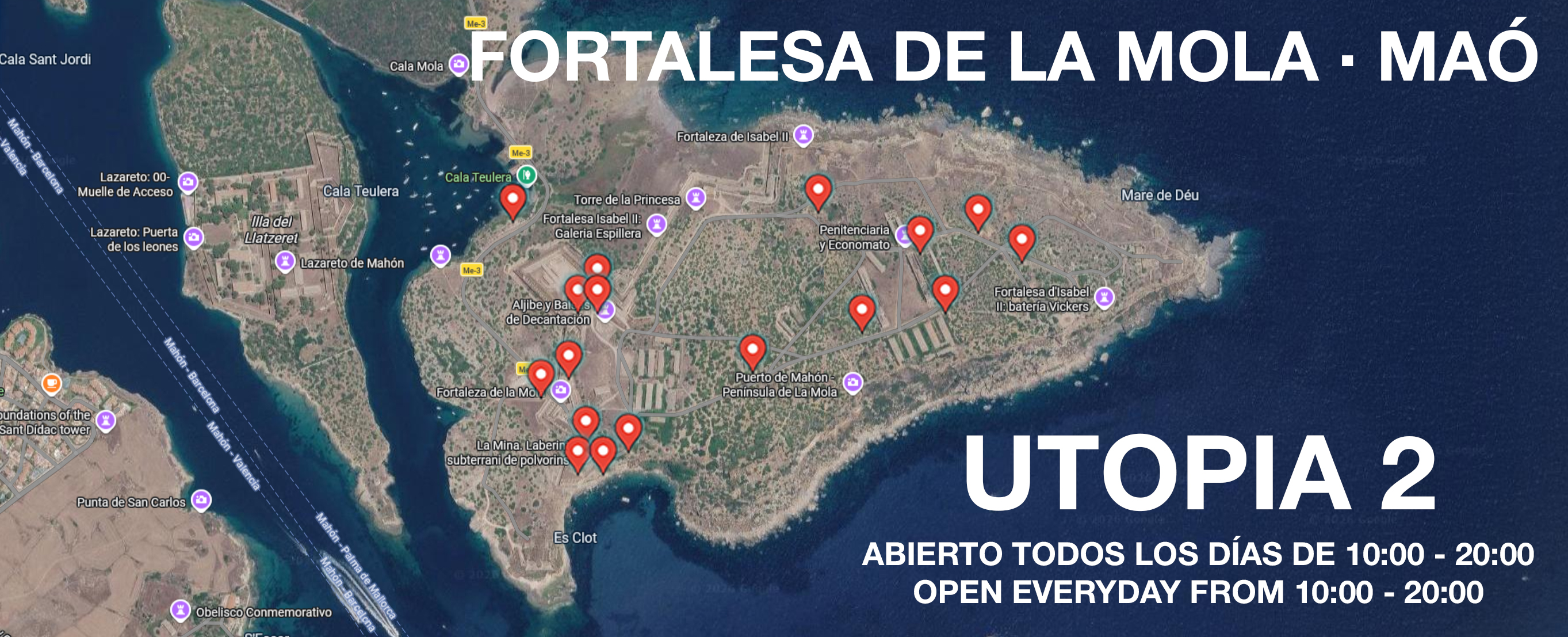
times are moving ahead of us. Utopia, the exhibition hosted by the
Fortress of La Mola in Maó (Menorca) and the Castle of San Carlos in
Palma (Mallorca), attempts, through the emblematic nature of these
spaces, to be a response to the contradictory feelings surrounding
globalization, wars, and the penetration of AI into everyday life,
which make it difficult to separate creation, freedom, and equality,
the driving forces of culture, from the fears of insubstantiality in
art.
As
an islander and a Mediterranean, I come from a past of peoples with
cultures that blend without disappearing, a past of constant change
and adaptation. As an artist, I am driven by curiosity. I believe
that imagination is the transformative force and that skills
strengthen your language; that attitude, freedom, and social ethics
give value to the truth of the work. Through my work, I strive to be
myself and to be the sea, and to be reborn like the waves with
torrents of desire for beauty, goodness, and freedom.
La
Pierre et le Livre · Utopies 2
L'utopie
est un “non-lieu”. C'est aussi cet ami imaginaire auquel Joseph
Brodsky dit s'adresser:
J'écris
pour le rencontrer,
et
pour faire la seule chose qu'on puisse faire
pour
un homme meilleur: continuer la conversation.
C'est
là, je crois, l'essence même des civilisations.
C'est
avec la dureté et le tranchant de la pierre que commença l'histoire
de l'être simiesque devenu sapiens. Sur elle, il sculpta son éveil
social et inscrivit ses codes de coexistence. Le livre est le
témoignage écrit de ses vicissitudes et de son aspiration à la
connaissance et à la compréhension. Les images de scènes de chasse
découvertes dans des grottes préhistoriques sont les premiers
témoignages de l'humanité dans sa lutte pour transcender et
maîtriser son environnement.
Aujourd'hui
le temps nous dépasse. Utopia, l'exposition présentée à la
Forteresse de La Mola à Mahon (Minorque) et au Château de San
Carlos à Palma (Majorque) tente, par le caractère emblématique de
ces lieux, de répondre aux sentiments contradictoires qui entourent
la mondialisation, les guerres et la pénétration de l'IA dans la
vie quotidienne, autant de facteurs qui rendent difficile de
dissocier la création, la liberté et l'égalité, forces motrices
de la culture, des craintes liées à l'insubstantialité de l'art.
En
tant qu'insulaire et Méditerranéen, je suis issu d'un passé où
les cultures se mêlent sans jamais disparaître, un passé en
perpétuelle évolution et d'adaptation. En tant qu'artiste, je suis
guidé par la curiosité, je crois que l'imagination est une force
transformatrice et que les compétences enrichissent ta langue; que
l'attitude, la liberté et l'éthique sociale donnent toute sa valeur
à l'œuvre. À travers mon travail, je m'efforce d'être moi-même
et d'être la mer, de renaître comme les vagues, porté par un
torrent de désir de beauté, de bonté et de liberté.